

The Math of Friendships: 50-90-200 hours rule
How much time we need to become confidants and why new adult friendships feel hard to build for most of us.

It may sound controversial to attach math to such a sacred topic of friendship. Sometimes, when I talk to people around me about the numbers or structure in friendships, I get a look that clearly says that we should not put “excel-like” approach to something that is so dear to our hearts. While I feel this way myself sometimes, I also want to have agency around how I build up one of the most important areas in my life, and I believe friendships and relations are the practice, not just hope. Hence, at some point I decided to better understand the underlying mechanics and try to make it work.
In 2018 Jeffrey Hall published the paper (link to the source for curious minds) which says that you need 50 hours spent with someone to move from an acquaintance to casual friendship, 90 hours to become friends and 200+ hours to get to close friendship. This has triggered a lot of changes in how I approach friendships now — this one is literally a catalyst for the blog, the app and many many conversations I have had and will have.
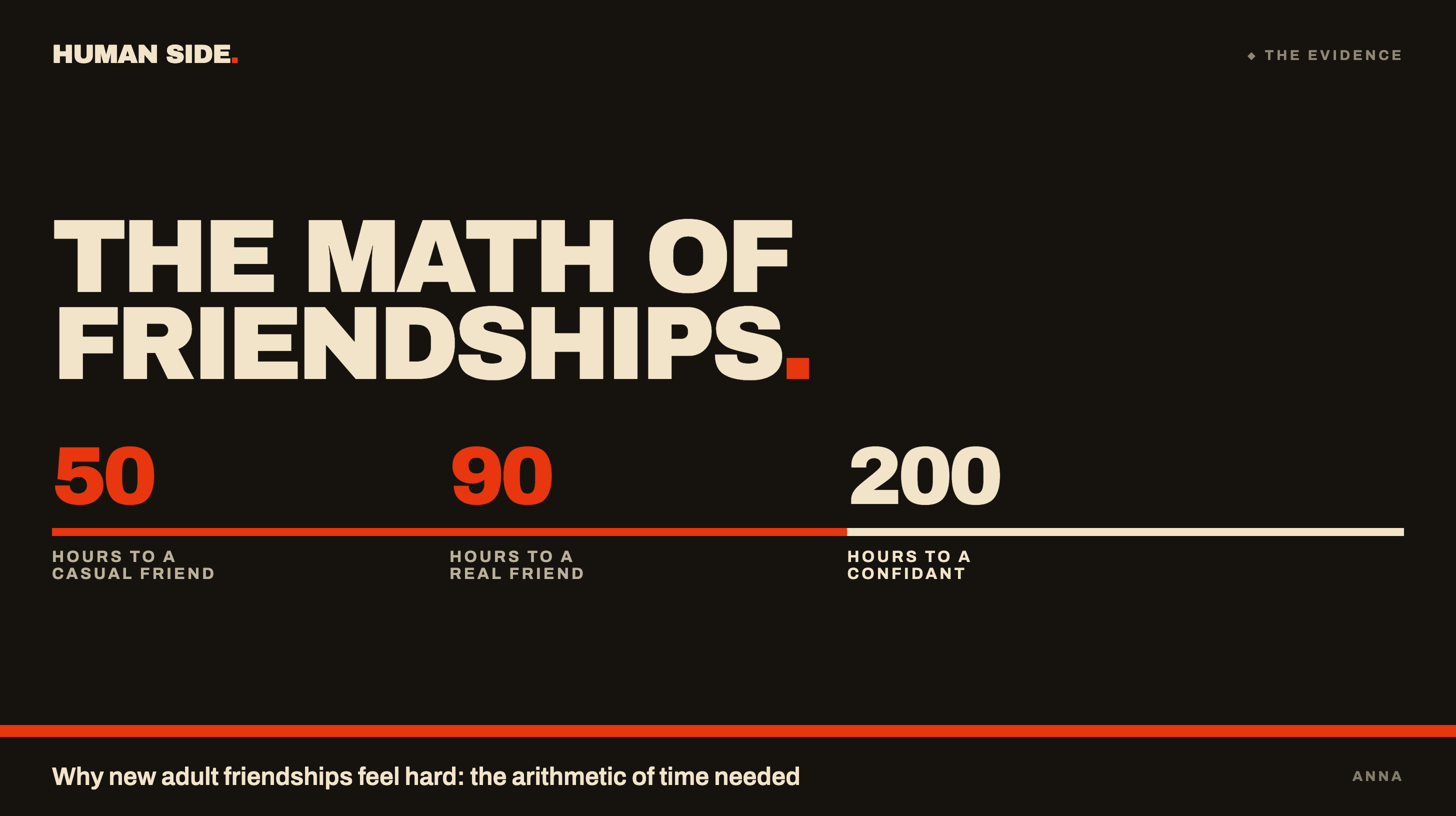
These results are drawn from two studies: one was focused on adults relocated to a new city and the other one on first year students. So, in both cases we have people in circumstances that were new to them and represented a moment of significant change in life. The researchers were looking at quality time spent together, conversations and shared leisure activities. If we transfer these learnings into our everyday reality, zoom alignment/transactional calls would not contribute to the time spent together.
Friends groups
Before we dive into implications, it’s also interesting to look at the typology of friends and levels of closeness to speak the same language. Hall is using Dunbar’s social brain hypothesis that says that humans can maintain around 150 connections (you might have heard this number in the organizational context as the Dunbar’s number of 150 which is the maximum for organizational cultures where people really know each other). In general, 150 connections is considered as the cognitive limit for maintaining relations and keeping track of joint history with others.
Within that theory, we have several groups, or circles, of people who we can consider “friends group”:
Support clique (loved ones, best friends) — 1-5 people: romantic partners, kin and may include nonkin close friends. These are close confidants who we spend about 40% of all social time with;
Sympathy group (close friends) — 10-15 people: deep friends (inclusive of support clique) who support each other regularly;
Friendship group (friends) — 40-50 people: friends who we invite to the parties and casually hang out with;
Active network / “Clansmen” (casual friends) — 120-150 people: wide group of people who we have personal history with and can have a coffee or a drink with them if we bump into them somewhere.
Acquaintances – larger circle of people who we met, but not have a rich history with.
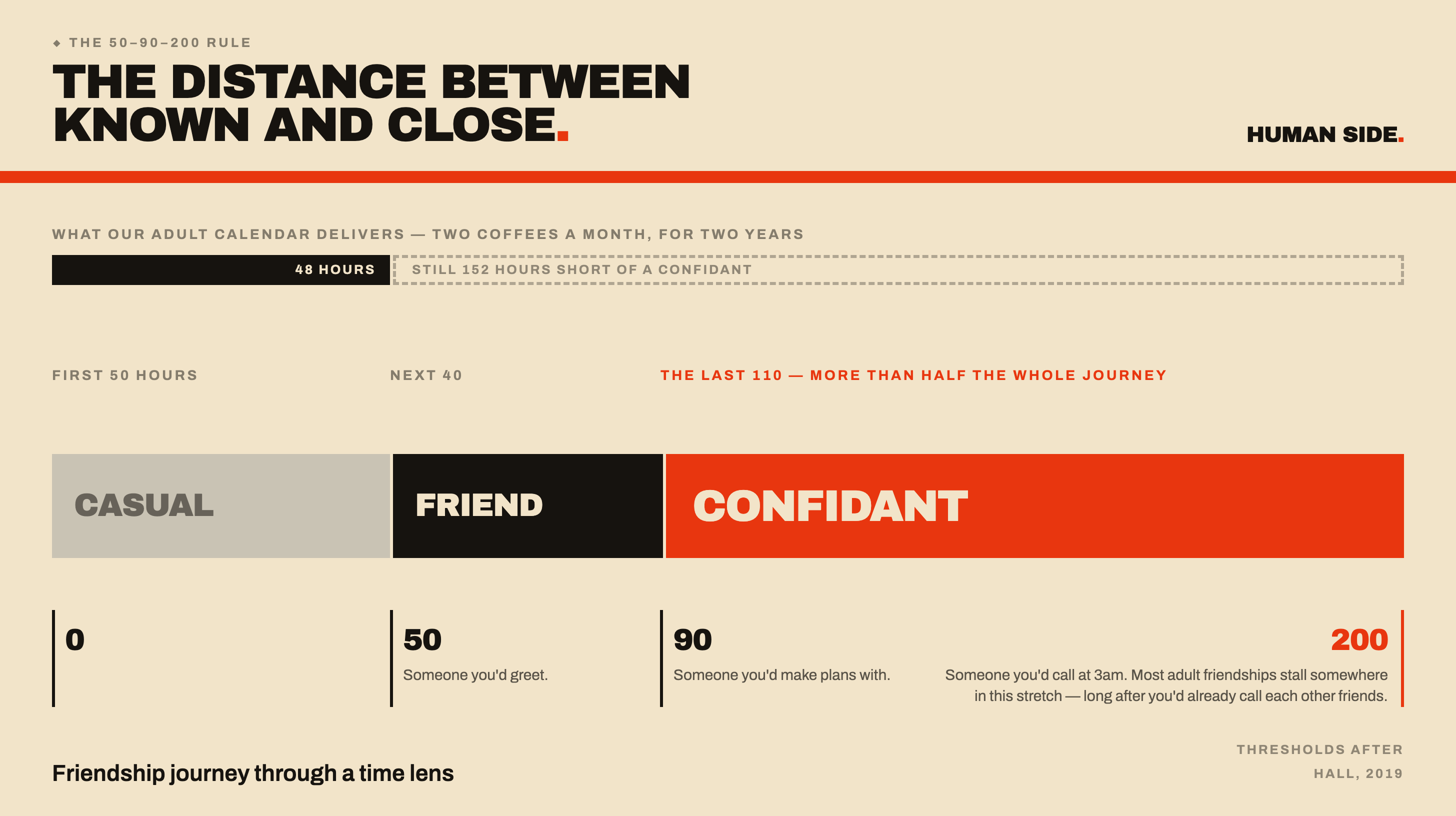
So, when we are talking about the hours needed to build relations, it (more or less) means that we need 50 hours to move from an acquaintance to a clansmen group (casual friends), 90 hours potentially get us to a friendship group (friends), and 200+ hours give us a chance to become a part of sympathy group (confidants, close friends). I would treat it as minimum, but not a guarantee that you will become friends with someone.
Some Implications
The numbers in research were eye-opening to me — for a long time I was struggling with building deep connections that are really fulfilling and lasting. Of course, I thought I was the only one. Reading through the research made me think of how much quality time I am spending with new acquaintances and what is the part of the work that is on me to actually progress the relations. Apparently, not enough.
So here are my reflections on these numbers:
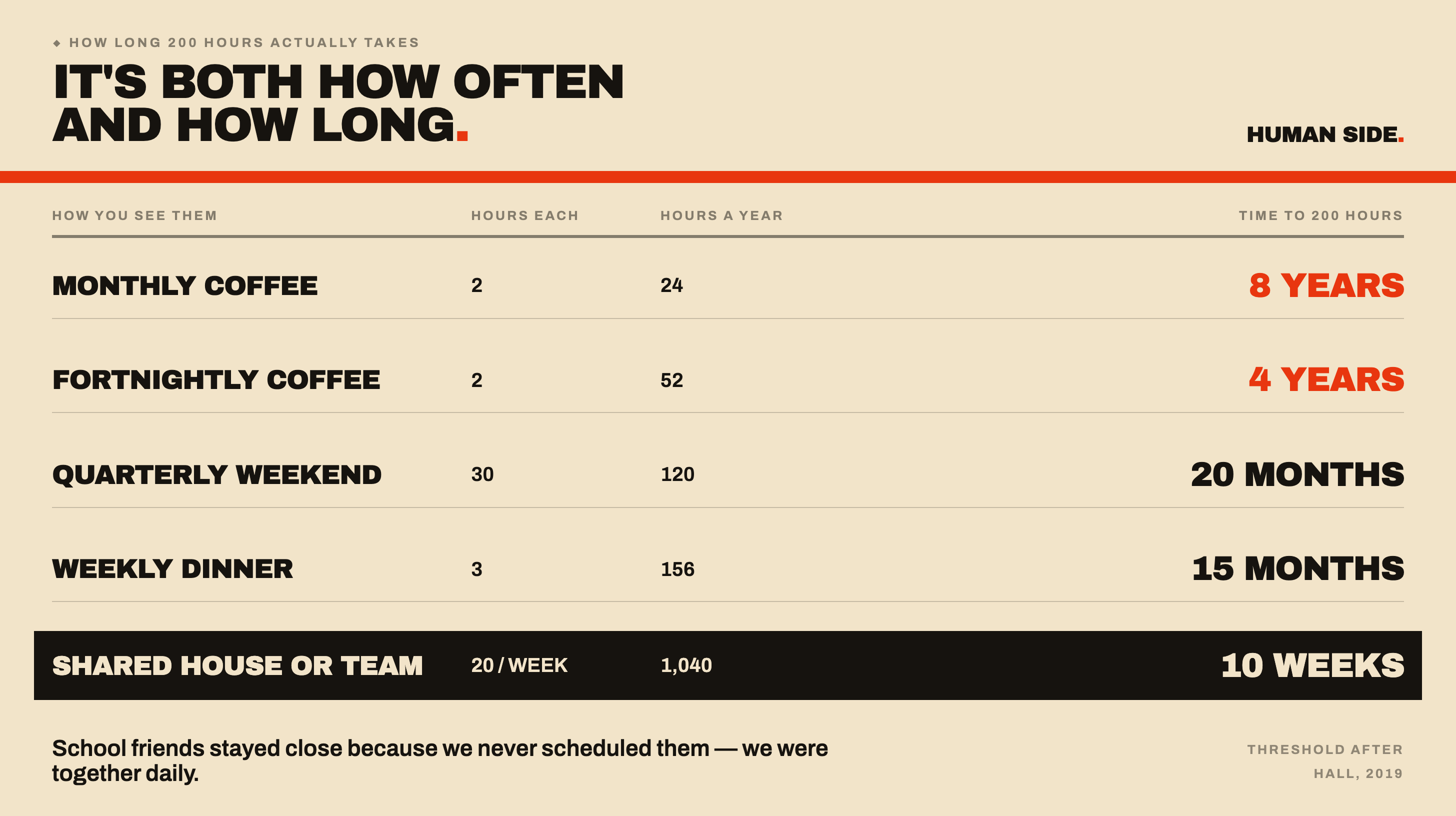
50 hours of quality time is A LOT. While I am meeting new people quite a lot now — at work, at the events or so-called “networking dinners” — not many of those encounters are becoming something more than a nice conversation. Usually there are just a few hours spent with people, and sometimes it already feels like a lot, but in reality it doesn’t convert to anything for either of us. If we need to spend at least 50 hours, it means that it’s roughly 1 hour / week for a year, or we can try to condense it to roughly 4 hours / week for a quarter.
If i try to remember my over coffee conversations with new people, most of them were 2-3 through the whole year. So 50 sounds like a real investment, and if we talk about 200+, it’s really a lot when juggling with our work, family and other responsibilities. What it means is that I should plan time for building relations and I cannot just hope to find it somewhere. Time whenI am present for people I am going to be friends with (hopefully) and not looking at my phone, slack or anywhere else, and not lost in thoughts. Quick math below shows what it can take.
I have to be proactive. This amount of quality time spent cannot be left for accidents. This puts me out of a comfort zone where I really need to go first sometimes, plan for things and don’t skip those brunches. Also, I do appreciate more and more now when people are inviting me or someone new to their circle to their birthday party, or lunch or just simple coffee. It is often a social risk, and I really really appreciate everyone who is taking those risks — it makes all new friendships possible.
Consistency is the key. It might sound boring, but showing up consistently is the key — whether it’s getting to the same dance class each week, or checking in every week and establishing a new Tuesday lunch tradition. Consistency gives us a chance to get familiar with our habits, reactions and behaviors, test the waters and eventually feel safe and be vulnerable around each other.
Self awareness and emotional regulation play a big role in deepening connections. Meeting new people sometimes opens a new world for us, as well as triggers some emotions that can be unexpected (in both positive and negative ways!). Understanding yourself helps us to be present, empathy helps us with building connection to the other person and helps them to feel seen, heard and understood. Investing in emotional literacy is essential for getting closer with one another.
I am not alone in the struggle. Even looking at the numbers and doing a simple math in my head, I realized that with all our social roles and responsibilities most of us simply do not carve out time for connection and hence there is a very high probability to meet someone who is struggling as I am and is longing for connection and belonging. Knowing that helps me to look at people with compassion and curiosity, as well as sharing my own experiences with a sense of loneliness. Paradoxically, this alone creates a solid foundation for a great conversation.
I don’t use these numbers to build an excel sheet for tracking my friendships and social interactions, but I definitely use them as a reminder for the time I spend with people. Our average screen time is growing and is around 7 hours per day globally, while social time is less than 1 hour on average. While it might feel good to spend time in our heads, the ratio of screen vs social is really worrying, and I am now using every good reason to talk to someone over watching their instagram feed, hoping for compounding effects of time spent together and getting to those 200+ real hours.